---
title: "Learning Harmony to integrate single cell RNA-seq data for batch borrection and meta analysis"
date: 2023-11-26
date-modified: last-modified
categories:
- r
- scRNA-seq
image: harmony.jpg
# draft: true
# execute:
# freeze: true
# # echo: false
# warning: false
# eval: false
description: Harmony allow integrating data across several variables (for example, by experimental batch and by condition), and significant gain in speed and lower memory requirements for integration of large datasets.
---
```{r setup, include=FALSE}
knitr::opts_chunk$set(
# fig.width = 6,
# fig.height = 3.8,
fig.align = "center",
# fig.retina = 3,
out.width = "100%",
warning = FALSE,
# evaluate = FALSE,
collapse = TRUE
)
```
```{r}
#| echo: false
#| warning: false
#| message: false
# BiocManager::install("harmony", force = TRUE)
# if (!requireNamespace("BiocManager", quietly = TRUE))
# install.packages("BiocManager")
# BiocManager::install("harmony", version = "3.8")
# devtools::install_github('immunogenomics/harmony', force = TRUE)
# devtools::install_github("JEFworks/MUDAN")
colors_use <- c(`jurkat` = '#810F7C', `t293` = '#D09E2D',`half` = '#006D2C')
### function for plot
do_scatter <- function(umap_use, meta_data, label_name, no_guides = TRUE,
do_labels = TRUE, nice_names,
palette_use = colors_use,
pt_size = 4, point_size = .5, base_size = 12,
do_points = TRUE, do_density = FALSE, h = 6, w = 8) {
umap_use <- umap_use[, 1:2]
colnames(umap_use) <- c('X1', 'X2')
plt_df <- umap_use %>% data.frame() %>%
cbind(meta_data) %>%
dplyr::sample_frac(1L)
plt_df$given_name <- plt_df[[label_name]]
if (!missing(nice_names)) {
plt_df %<>%
dplyr::inner_join(nice_names, by = "given_name") %>%
subset(nice_name != "" & !is.na(nice_name))
plt_df[[label_name]] <- plt_df$nice_name
}
plt <- plt_df %>%
ggplot2::ggplot(aes_string("X1", "X2", col = label_name, fill = label_name)) +
theme_test(base_size = base_size) +
theme(panel.background = element_rect(fill = NA, color = "black")) +
guides(color = guide_legend(override.aes = list(stroke = 1, alpha = 1,
shape = 16, size = 4)),
alpha = FALSE) +
scale_color_manual(values = palette_use) +
scale_fill_manual(values = palette_use) +
theme(plot.title = element_text(hjust = .5)) +
labs(x = "PC 1", y = "PC 2")
if (do_points)
plt <- plt + geom_point(shape = '.')
if (do_density)
plt <- plt + geom_density_2d()
if (no_guides)
plt <- plt + guides(col = FALSE, fill = FALSE, alpha = FALSE)
if (do_labels) {
data_labels <- plt_df %>%
dplyr::group_by_(label_name) %>%
dplyr::summarise(X1 = mean(X1), X2 = mean(X2)) %>%
dplyr::ungroup()
plt <- plt + geom_label(data = data_labels, label.size = NA,
aes_string(label = label_name),
color = "white", size = pt_size, alpha = 1,
segment.size = 0) +
guides(col = FALSE, fill = FALSE)
}
return(plt)
}
### library
library(harmony)
library(MUDAN)
library(Seurat)
library(tidyverse)
library(here)
library(cowplot)
```
## Harmony to integrating cell line datasets from 10X
```{r}
#| warning: false
data(cell_lines)
scaled_pcs <- cell_lines$scaled_pcs
meta_data <- cell_lines$meta_data
### cells cluster by dataset initially
p1 <- do_scatter(scaled_pcs, meta_data, "dataset") +
    labs(title = "Colored by dataset")
p2 <- do_scatter(scaled_pcs, meta_data, "cell_type") +
    labs(title = "Colored by cell type")
### combine plot
cowplot::plot_grid(p1, p2)
```
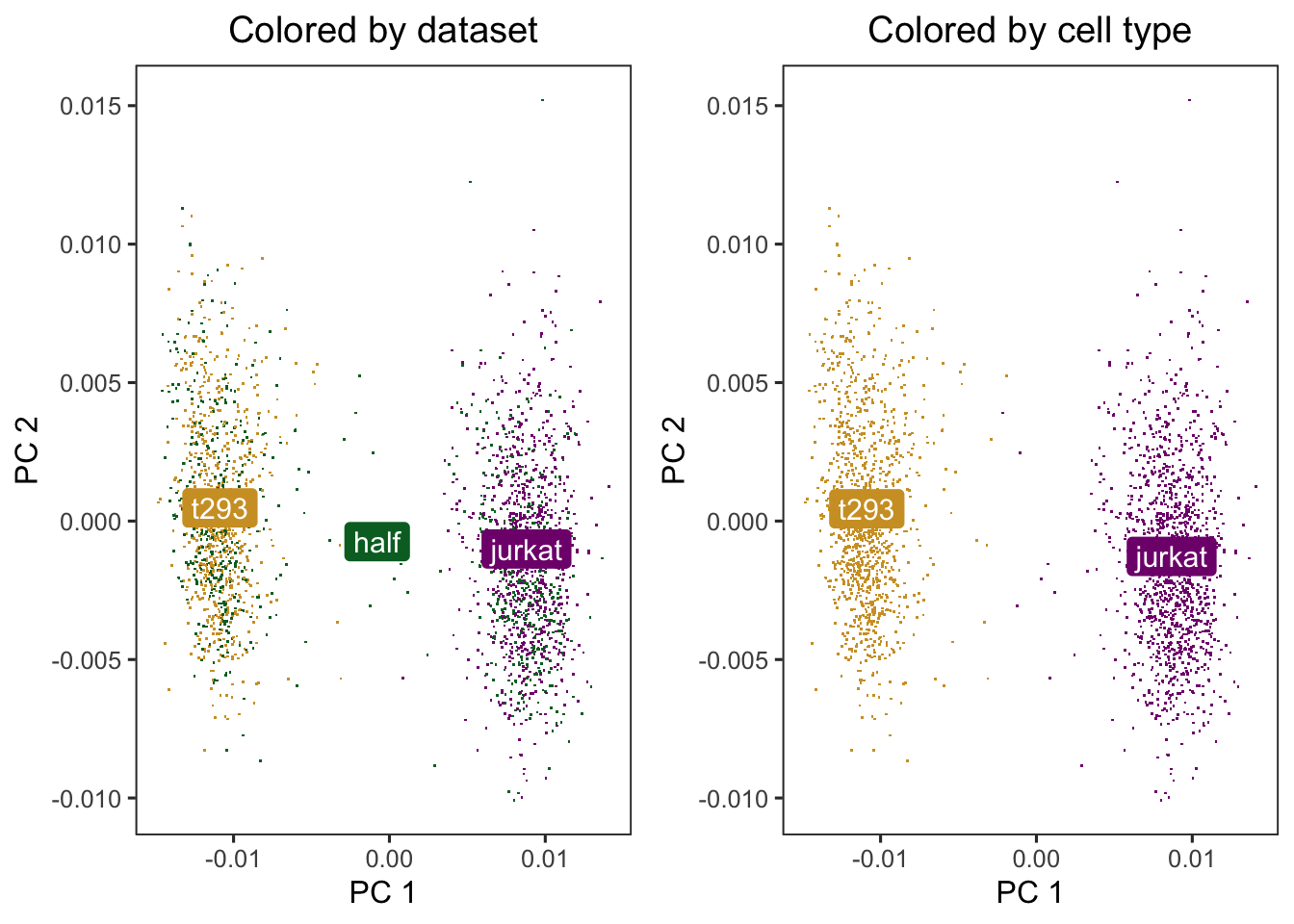
Run harmonoy to remove the influence of dataset-of origin from ceel embeddings. After Harmony, the datasets are now mixed and the cell types are still separate.
```{r}
#| warning: false
harmony_embeddings <- harmony::RunHarmony(
    scaled_pcs, meta_data, "dataset", verbose = FALSE
)
p1 <- do_scatter(harmony_embeddings, meta_data, "dataset") +
labs(title = "Colored by dataset")
p2 <- do_scatter(harmony_embeddings, meta_data, "cell_type") +
    labs(title = "Colored by cell type")
### combine plot
cowplot::plot_grid(p1, p2, nrow = 1)
```
## MUDAN
```{r}
#| eval: false
### get data
data("pbmcA")
data("pbmcB")
dim(pbmcA)
dim(pbmcB)

### downsize the number of cells in each PBMC dataset
pbmcA <- pbmcA[, 500] # take 500 cells
pbmcB <- pbmcB[, 2000] # take 500 cells
```
Combine the two datasets into one cell by gene counts matrix and use a meta vector to keep track of which cell belongs to which sample
```{r}
#| eval: false
### combine into one coutns matrix
genes_int <- intersect(rownames(pbmcA), rownames(pbmcB))
cd <- cbind(pbmcA[genes_int, ], pbmcB[genes_int, ])

### meta data
meta <- c(rep("pbmcA", ncol(pbmcA)), rep("pbmcB", ncol(pbmcB)))
names(meta) <- c(colnames(pbmcA), colnames(pbmcB))
meta <- factor(meta)

cd[1:5, 1:2]
meta[1:5]
```
Given this counts matrix, we can normalize our data, derive principal components, and perform dimensionality reduction using tSNE. However, we see prominent separation by sample due to batch effects.
```{r}
#| eval: false
### CPM normalization
mat <- MUDAN::normalizeCounts(cd, verbose = FALSE)

### variance normalize, identify overdispersed genes
matnorm_info <- MUDAN::normalizeVariance(mat, details = TRUE, verbose = FALSE)

### log transform
matnorm <- log10(matnorm_info$mat + 1)

### 30 PCs on over dispersed genes
pcs <- MUDAN::getPcs(
    matnorm[matnorm_info$ods, ],
    nGenes = length(matnorm_info$ods),
    nPcs = 30,
    verbose = FALSE
)
### TSNE embedding with regular PCS
emb <- Rtsne::Rtsne(
    pcs,
    is_distance = FALSE,
    perplexity = 30,
    num_threads = 1,
    verbose = FALSE
)$Y
rownames(emb) <- rownames(pcs)
### plot
par(mfrow = c(1, 1), mar = rep(2, 4))
MUDAN::plotEmbedding(
    emb, groups = meta, show.legend = TRUE,
    xlab = NA, ylab = NA,
    main = "Regular tSNE Embedding",
    verbose = FALSE
)
```
Indeed, when we inspect certain cell-type specific marker genes (MS4A1/CD20 for B-cells, CD3E for T-cells, FCGR3A/CD16 for NK cells, macrophages, and monocytes, CD14 for dendritic cells, macrophages, and monocytes), we see that cells are separating by batch rather than by their expected cell-types.
```{r}
#| eval: false
par(mfrow = c(2, 2), mar = rep(2, 4))
invisible(
    lapply(
        c("MS4A1", "CD3E", "FCGR3A", "CD14"),
        function(x) {
            gexp <- log10(mat[x, ] + 1)
            plotEmbedding(
                emb, col = gexp, xlab = "NA",
                ylab = NA, main = x,
                verbose = FALSE
            )
        }
    )
)
```
If we were attempt to identify cell-types using clustering analysis at this step, we would identify a number of sample-specific clusters driven by batch effects.
```{r}
#| eval: false
annot_bad <- getComMembership(pcs, k = 30, method = igraph::cluster_louvain)
par(mfrow = c(1, 1), mar = rep(2, 4))
plotEmbedding(
    emb, groups = annot_bad, show.legend = TRUE,
    xlab = NA, ylab = NA,
    main = "Jointly-indentified cell clusters",
    verbose = FALSE
)
```
```{r}
#| eval: false
### look at cell-type proportion per sample
t(table(annot_bad, meta))/as.numeric(table(meta))
# Look at cell-type proportions per sample
# print(t(table(annot_bad, meta))/as.numeric(table(meta)))
```
## Using Harmony with Seurat
```{r}
### load required data
data("pbmc_stim")
### generate seurat object
pbmc <- CreateSeuratObject(
counts = cbind(pbmc.stim, pbmc.ctrl),
project = "PBMC",
min.cells = 5
)
### separete conditions
pbmc@meta.data$stim <- c(
rep("STIM", ncol(pbmc.stim)),
rep("CTRL", ncol(pbmc.ctrl))
)
### generate a union of highly variable genes
pbmc <- pbmc |> Seurat::NormalizeData(verbose = FALSE)
VariableFeatures(pbmc) <- split(row.names(pbmc@meta.data), pbmc@meta.data$stim) %>% lapply(function(cells_use) {
pbmc[,cells_use] %>%
FindVariableFeatures(selection.method = "vst", nfeatures = 2000) %>%
VariableFeatures()
}) %>% unlist %>% unique
pbmc <- pbmc |>
ScaleData(verbose = FALSE) |>
RunPCA(features = VariableFeatures(pbmc), npcs = 20, verbose = FALSE)
```
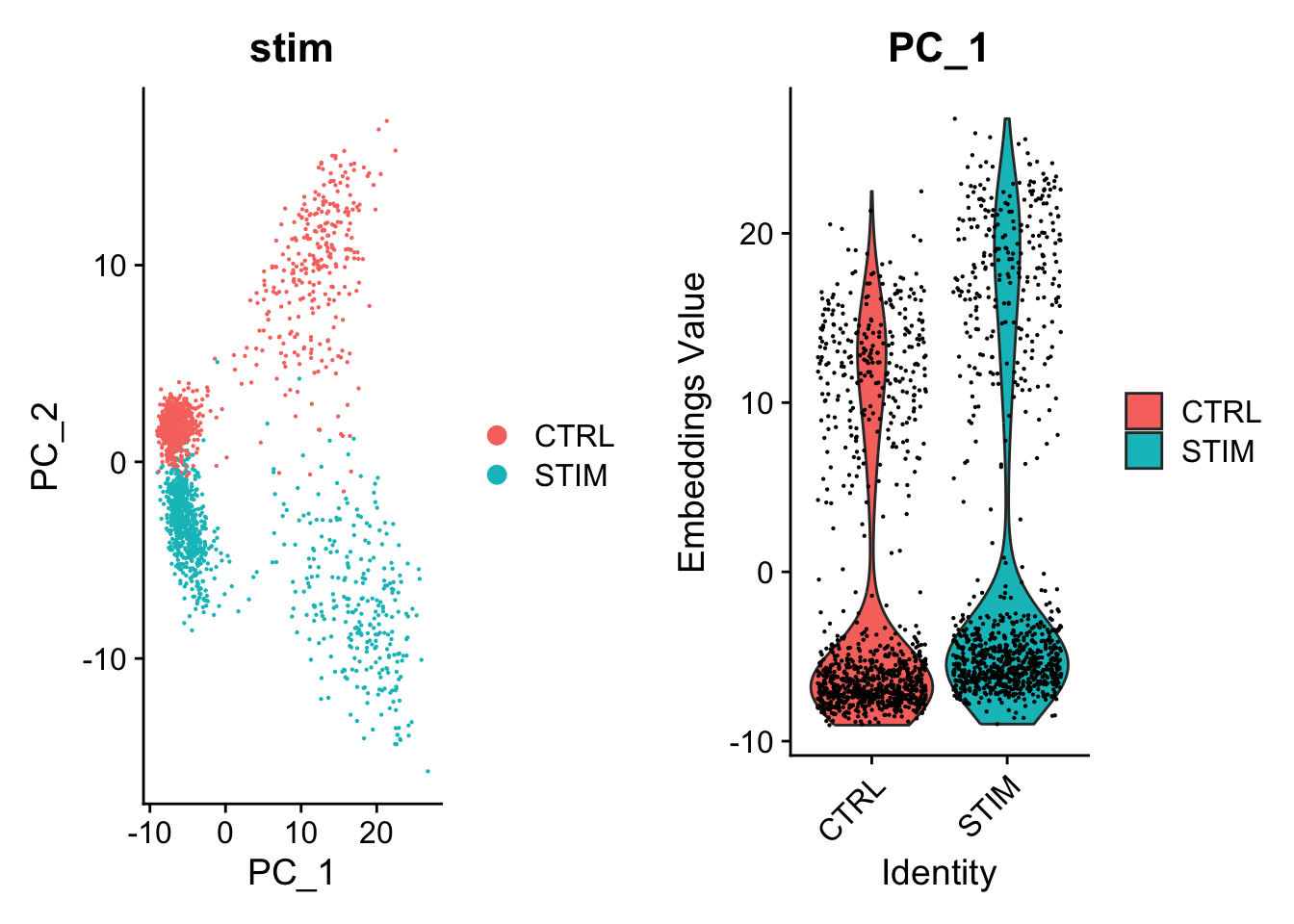
Clear difference between the datasets in the uncorrected PCs
```{r}
p1 <- DimPlot(object = pbmc, reduction = "pca", pt.size = .1, group.by = "stim")
p2 <- VlnPlot(object = pbmc, features = "PC_1", group.by = "stim", pt.size = .1)
cowplot::plot_grid(p1,p2)
```
### Run Harmony
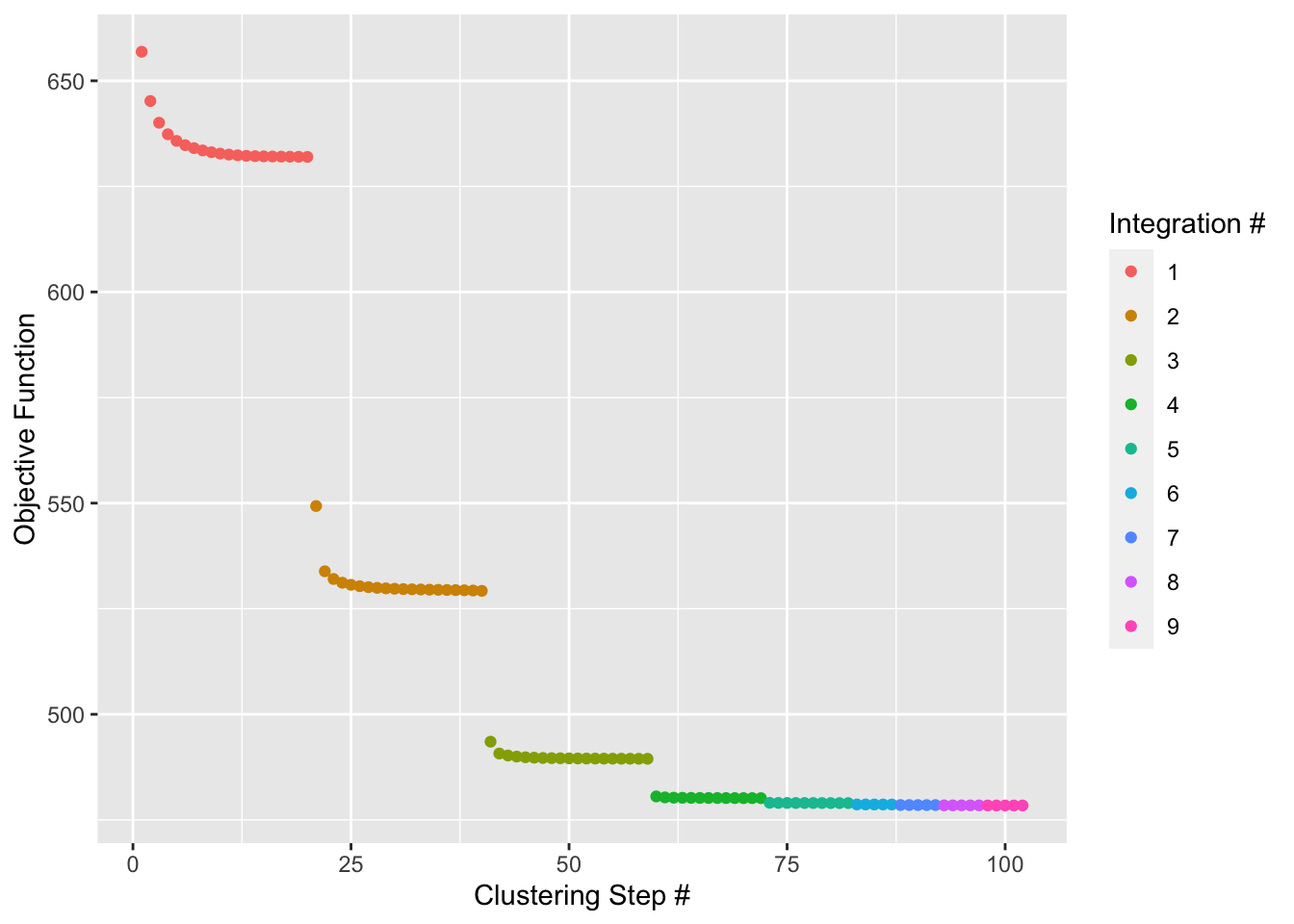
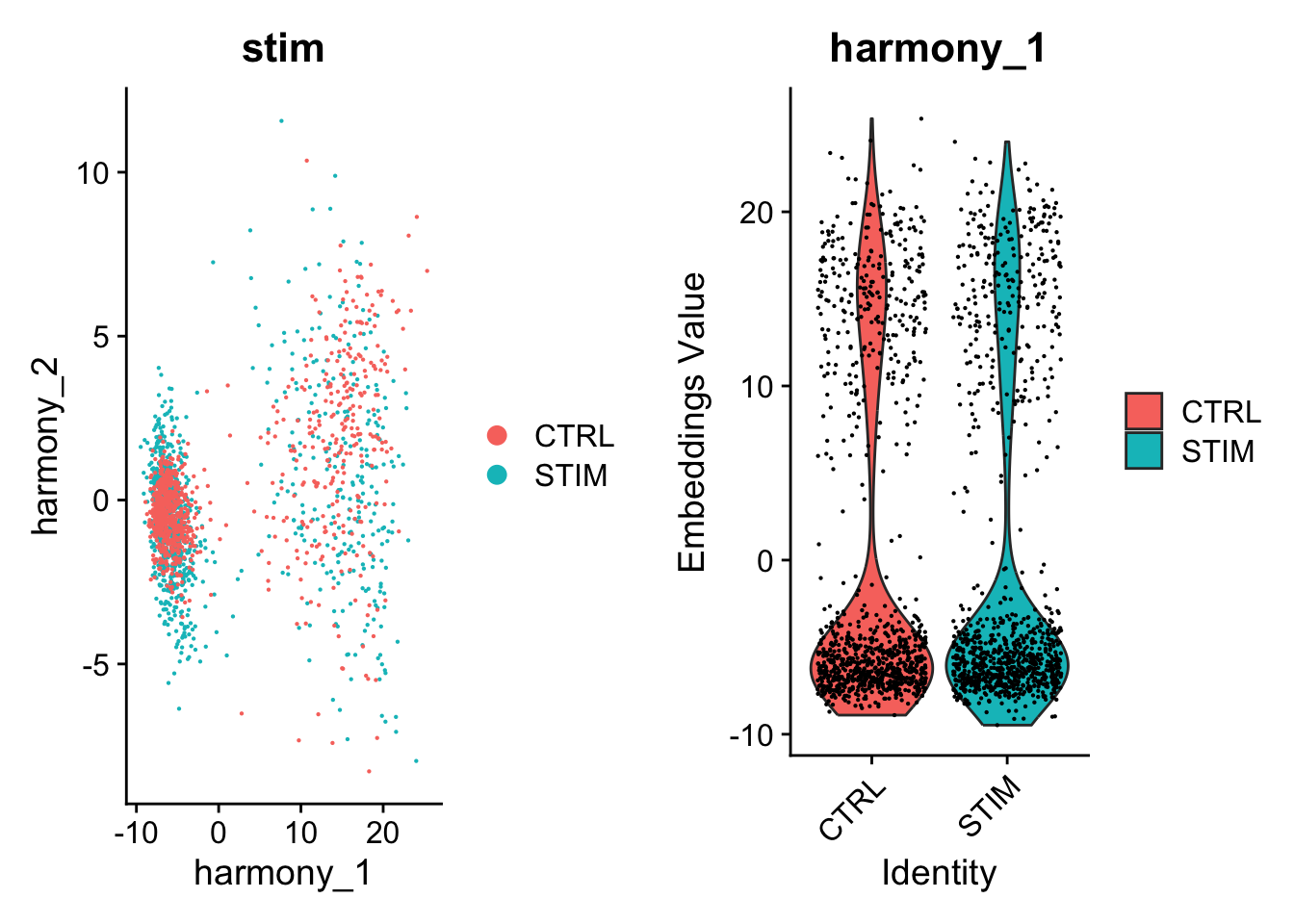
Harmony works on an existing matrix with cell embeddings and outputs its transformed version with the datasets aligned according to some user-defined experimental conditions.
```{r}
### run harmony to perform integrated analysis
pbmc <- RunHarmony(pbmc, "stim", plot_convergence = TRUE)
### directly access the new harmony embeddings
harmony_embeddings <- Embeddings(pbmc, "harmony")
harmony_embeddings[1:5, 1:5]
### inspection of the modalities
p1 <- DimPlot(object = pbmc, reduction = "harmony", pt.size = .1, group.by = "stim")
p2 <- VlnPlot(object = pbmc, features = "harmony_1", group.by = "stim", pt.size = .1)
plot_grid(p1,p2)
```
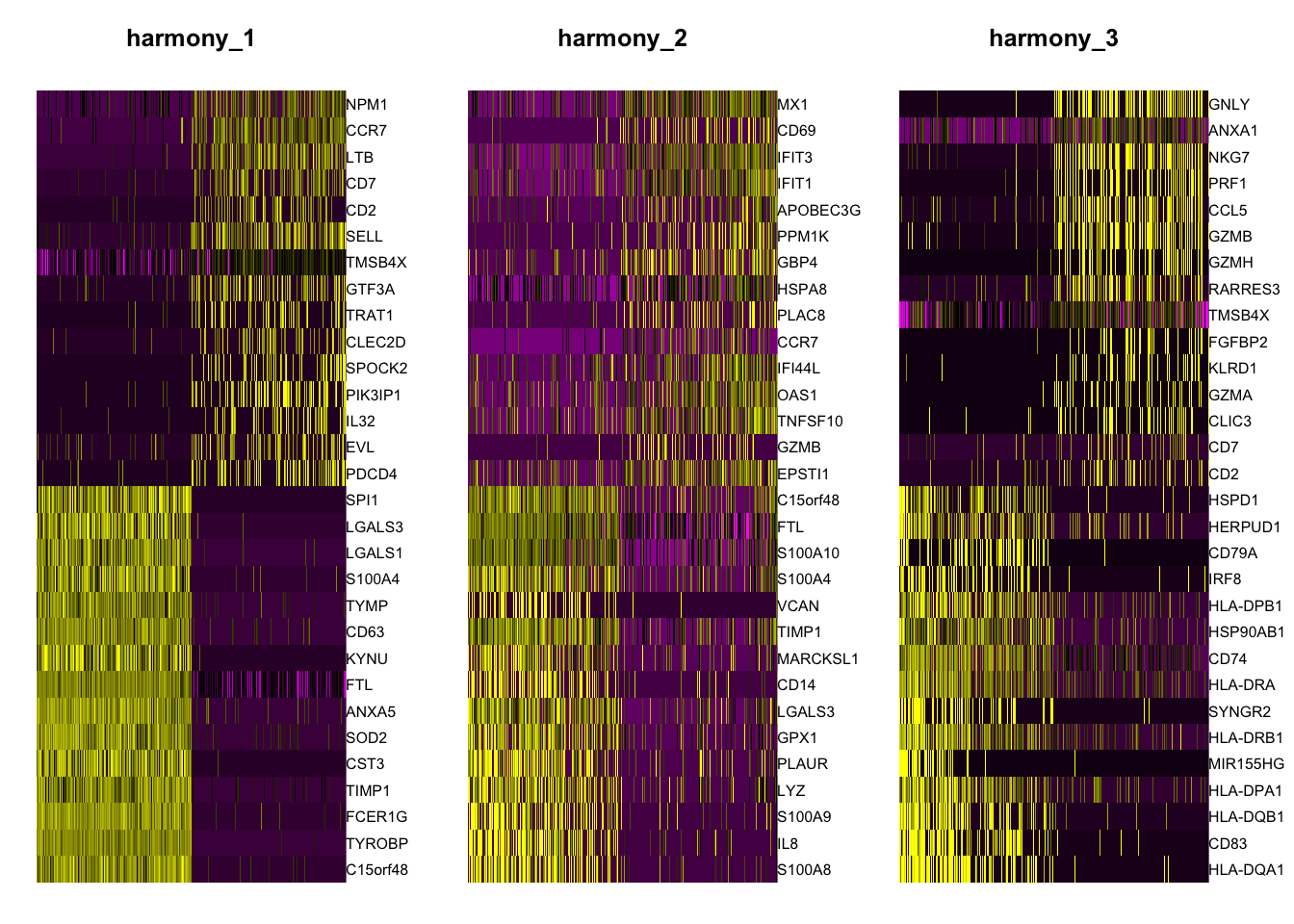
Plot genes correlated with the harmonized PCs
```{r}
DimHeatmap(object = pbmc, reduction = "harmony", cells = 500, dims = 1:3)
```
### Down stream analysis
```{r}
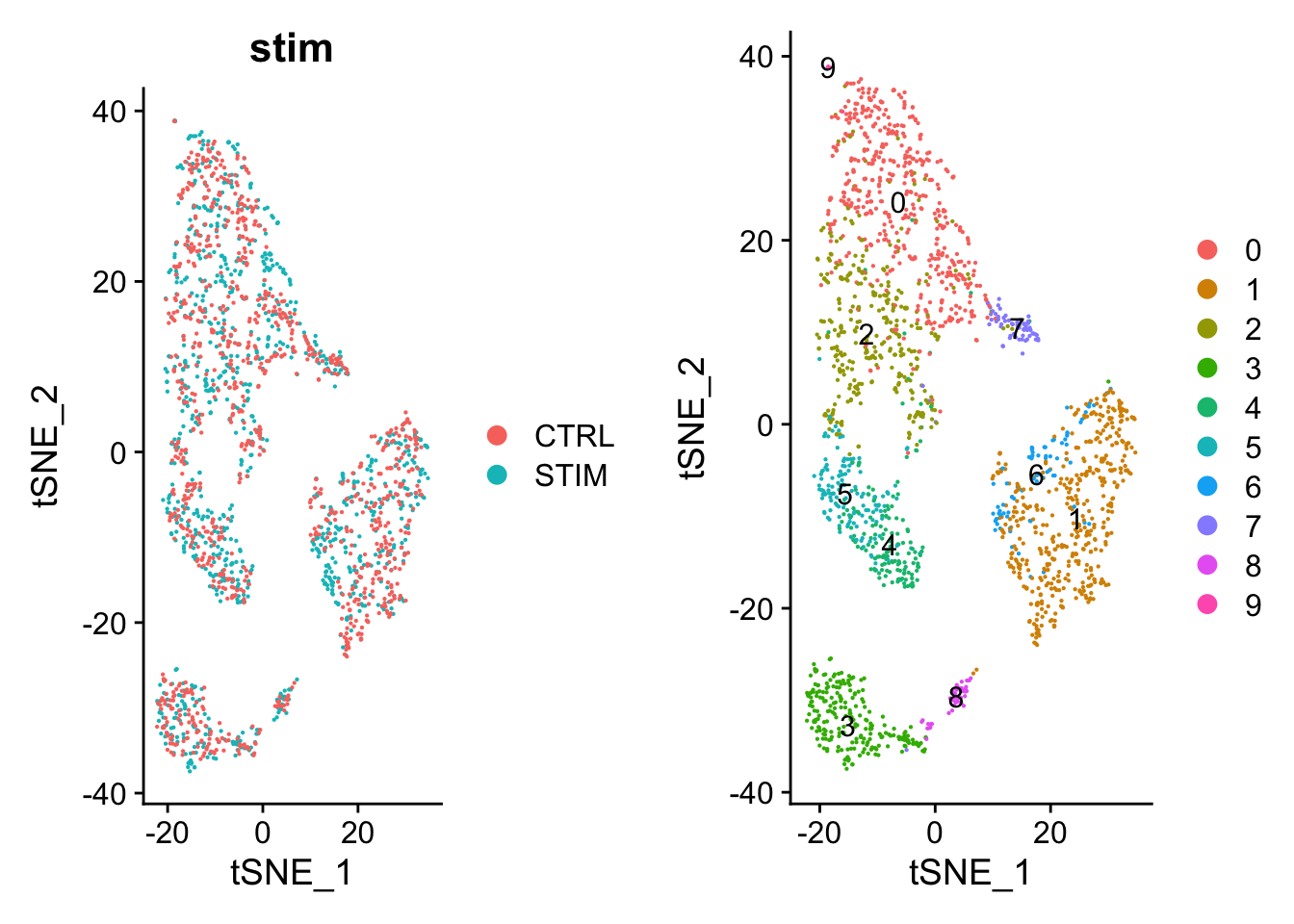
pbmc <- pbmc |>
### perform clustering using the harmonized vectors of cells
FindNeighbors(reduction = "harmony", dims = 1:20) |>
FindClusters(resolution = 0.5) |>
identity()
### TSNE
pbmc <- pbmc %>%
RunTSNE(reduction = "harmony")
p1 <- DimPlot(pbmc, reduction = "tsne", group.by = "stim", pt.size = .1)
p2 <- DimPlot(pbmc, reduction = "tsne", label = TRUE, pt.size = .1)
plot_grid(p1, p2)
```
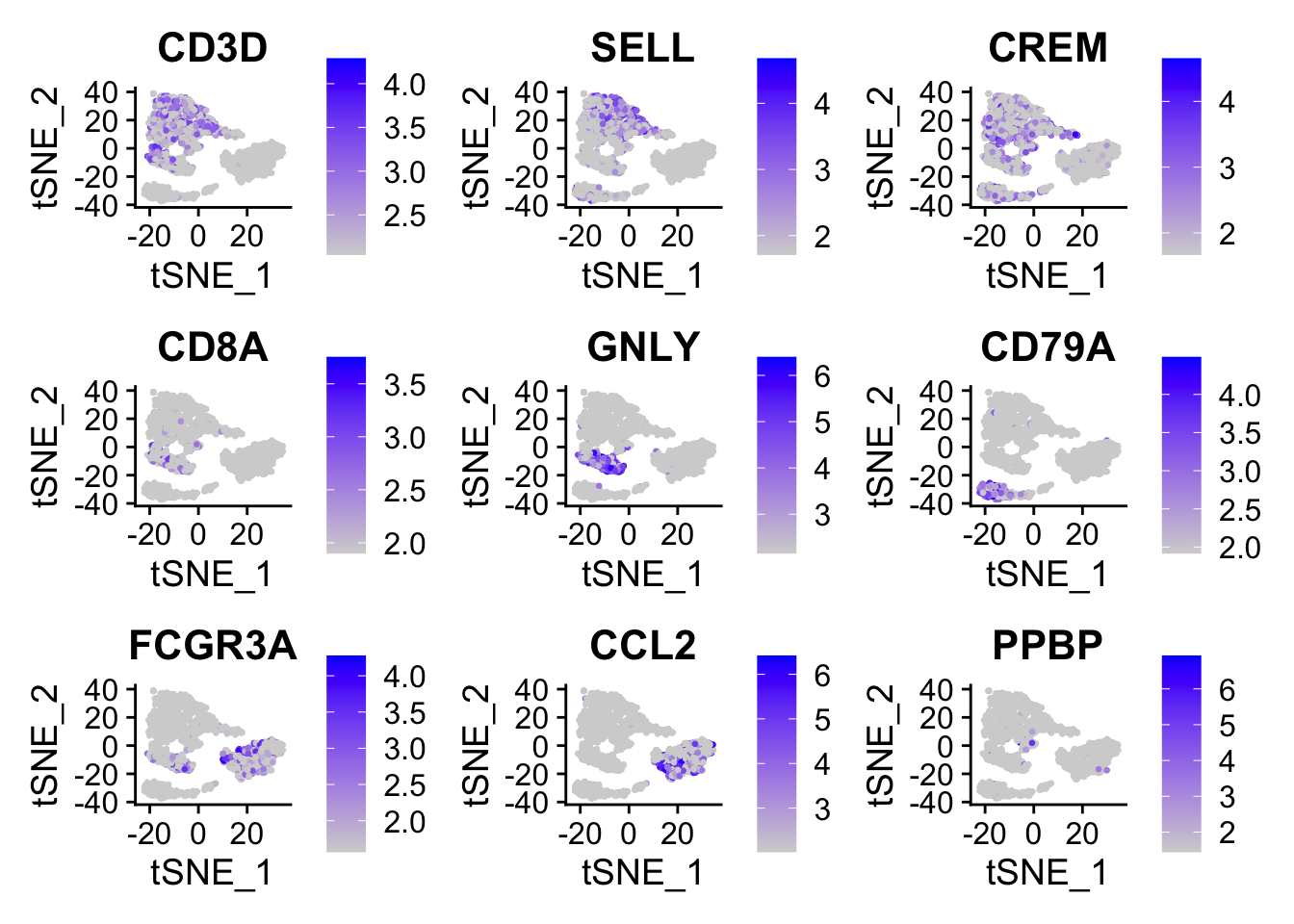
One important observation is to assess that the harmonized data contain biological states of the cells. Therefore by checking the following genes we can see that biological cell states are preserved after harmonization.
```{r}
FeaturePlot(object = pbmc, features= c("CD3D", "SELL", "CREM", "CD8A", "GNLY", "CD79A", "FCGR3A", "CCL2", "PPBP"),
            min.cutoff = "q9", cols = c("lightgrey", "blue"), pt.size = 0.5)
```
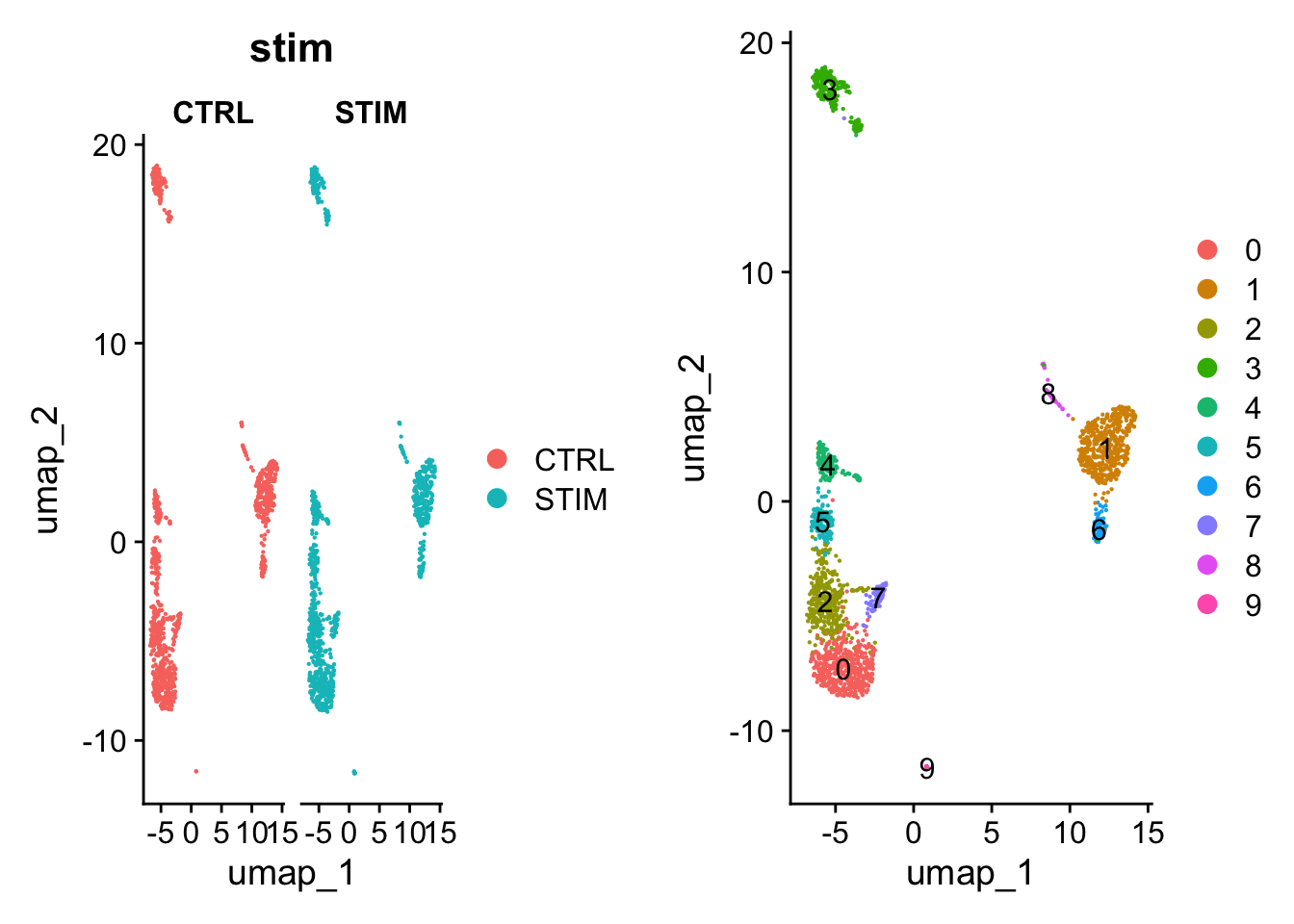
```{r}
### UMAP
pbmc <- pbmc |>
RunUMAP(reduction = "harmony", dims = 1:20)
p1 <- DimPlot(pbmc, reduction = "umap", group.by = "stim", pt.size = .1, split.by = 'stim')
### identify shared cell types with clustering analysis
p2 <- DimPlot(pbmc, reduction = "umap", label = TRUE, pt.size = .1)
plot_grid(p1, p2)
```
## Reference
- <https://portals.broadinstitute.org/harmony/index.html>
- [Single-cell RNA-seq: Integration with Harmony](https://hbctraining.github.io/scRNA-seq_online/lessons/06a_integration_harmony.html)
## Session info
```{r}
sessionInfo()
```